
 EN
EN DE
DE IT
IT FR
FR ES
ES RU
RU JP
JP RO
RO
© Daniel Jäger
Libuše
Order tickets
 March 2030 March 2030 | ||||||
|---|---|---|---|---|---|---|
Mo | Tu | We | Th | Fr | Sa | Su |
Libuše - Bedřich Smetana | Opera
A legend? A myth? Perhaps, first and foremost, a story conveying a message of wisdom that many a contemporary “ruler” has failed to take to heart.
Approximate Running Time: 3 hours 20 minutes, 2 intermissions (20 minutes each)
Language: Performed in Czech, with surtitles in Czech and English
The speculations about whether Libuše is Bedřich Smetana’s most mature work within the context of his opera oeuvre, or even within the context of Czech opera in general, whether and how it can stand its ground as against the airiness of The Bartered Bride, the lyricism and absorptive power of Dvořák’s Rusalka, or the emotion and drama of Leoš Janáček’s operas, do not result in definitive conclusions – it will always depend on the angle from which Libuše and any other renowned Czech opera is viewed.
The visual angle that appertains to Libuše most naturally is determined by the very intention pursued by the composer and the consequent tradition. Bedřich Smetana earmarked Libuše for being performed on the festive occasions relating to the life of Czech society, which after 1860 had begun markedly and palpably emancipating itself in terms of culture, politics and economics. Such an occasion was a seminal event in the history of Czech society – the opening of the National Theatre, first temporarily in 1881, and definitively two years later. An event that at the symbolic level widely transcended the narrow universe of Czech theatre-making and became one of the inherent harbingers of the attainment of independence in 1918. Accordingly, the centenary of the foundation of the Czechoslovak Republic was a momentous anniversary for the National Theatre itself, thus affording it the opportunity to create a new production of Libuše as a natural contribution to the celebrations.
There are several genre attributions by means of which we try to characterise Libuše, with one of them being a “scenic ritual of conciliation and purgation”. At variance with the expectations placed on an opera dramatist, Smetana does not sharpen the conflicts and antimonies in Libuše, deliberately seeking instead the path to their timely pacific settlement. Whether it concerns the main plot-forming dispute between two brothers about the inheritance after their late father, the antagonisms between a man and a woman, rigorous justice and friendly amiability, between those of “plebeian” and “noble” decent, between the motifs of light and darkness, all the conflicts in Smetana’s opera are redeemed in the central character of Princess Libuše, who is not just a mythical sovereign foretelling glory for the Czech nation but, first and foremost, a cathartic fabulous symbol of womanhood and motherhood, clemency and peaceful life.
Suitable for audience from 10 years.
National Theatre Chorus
National Theatre Orchestra
Prague Philharmonic Children’s Choir
Charles University Choir
Program and cast
Conductor: Jaroslav Kyzlink
Libuše: Mária Porubčinová
Přemysl of Stadice: Jiří Brückler
Chrudoš from Otava: František Zahradníček
Šťáhlav on Radbuza: Richard Samek
Lutobor of Dobroslavský Chlumec: Pavel Švingr
Radovan of Kamen Most: Aleš Jenis
Krasava: Tamara Morozová
Radmila: Jana Sýkorová
First harvestman: Veronika Kaiserová
Second harvestman: Lucie Hájková
Third harvestman: Yvona Škvárová
Fourth harvestman: Petr Dvořák
Stage director: Jan Burian
Staging and movement collaboration: Petr Zuska
Set and Light design: Daniel Dvořák
Costumes: Kateřina Štefková
Chorus master: Pavel Vaněk
Dramaturgy: Ondřej Hučín
National Theatre Chorus
National Theatre Orchestra
National Theatre Opera Ballet
Prague Philharmonic Children’s Choir
Charles University Choir
Prague National Theatre
The National Theatre today
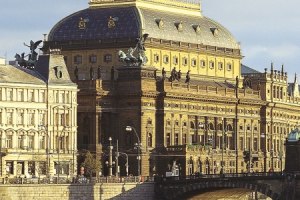
The historical building of the National Theatre, constructed in 1883, is generally considered the prime stage in the CzechRepublic. It is the flagship of the National Theatre institution, today amounting to five buildings and encompassing four companies. You can see there Opera, Drama and Ballet performances.
Practical information
Where to buy tickets
When purchasing tickets online, you will receive an e-ticket, which does not need to be printed—you can simply present it on your device upon entry. When available, you may also choose to collect printed tickets from the National Theatre box offices, and any tickets purchased directly at the box office will be issued in physical form.
The National Theatre sells tickets up to 6 months in advance.
Sales always start on the 1st day of the month at 9am, except in January when pre-sales do not start until the 2nd day due to a public holiday.
When do the doors open prior the show?
The National Theatre, The State Opera and the Estates Theatre are open 45 minutes prior the performance in time of increased hygiene practices. The evening box offices are open at the same time.
The main box office at the New Stage on play days is open until the beginning of the show. The New Stage auditorium is open 30 minutes prior the performance.
What kind of dress is suitable for attending the theatre?
Dress codes are only required for special events. By their appearance, the visitors indicate that they are aware of the festive occasion they are experiencing at the theatre. Persons in markedly soiled clothes and persons whose behaviour may compromise the safety of the other visitors are not allowed to enter the respective premises, or can be ejected from them.
Where do I park?
While visiting the National Theatre and the New Stage, you are welcome to use the underground National Theatre car park (access from Ostrovní Street). Please note that the parking is subject to a fee.
Only non-cash payments: Parking fees can be paid exclusively by cashless payment card or another virtual device (watch or phone). Thank you for your understanding
Buffets at the State Opera
No waiting. For your benefit, please pre-order your food and beverages at the bar to minimize waiting in the queue!
Accessibility for the disabled
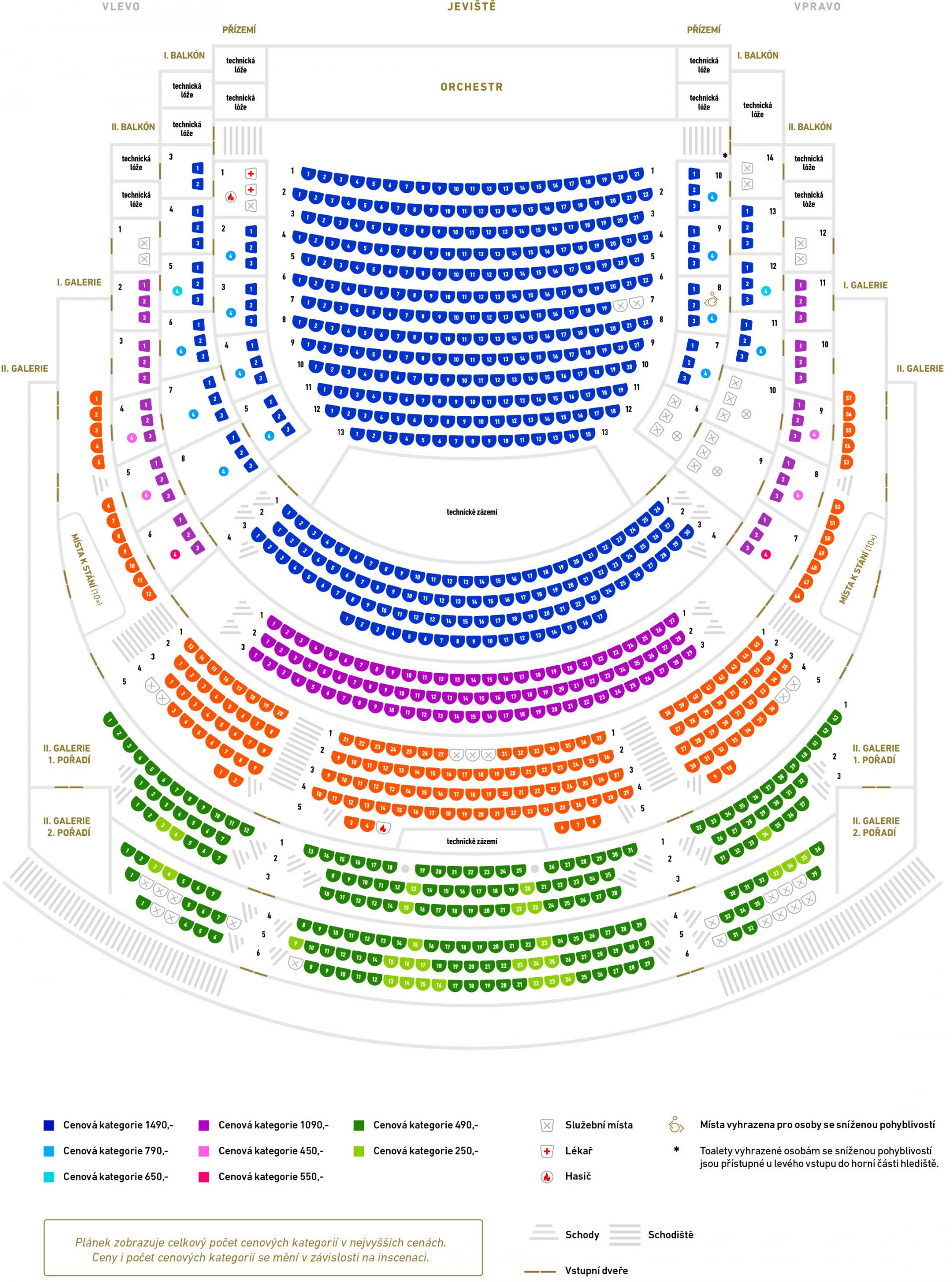
All the National Theatre venues are accessible to disabled persons, with special seats allocated for them in the auditorium. It is, however, advisable to consult each visit in advance with the National Theatre Sales Department.
Can I get an artist’s signature? Can I leave them flowers?
The National Theatre does not provide signatures of artists or contacts to them. You can leave flowers for artists performing in the show before its beginning at the theatre stuff.
Idea of building a stately theatre for the Czech nation
The National Theatre is the embodiment of the will of the Czech nation for a national identity and independence. Collections of money among the broad mass of the people facilitated its construction and hence the ceremonial laying of its foundation stone on 16 May 1868 was tantamount a nationwide political manifestation.
The idea of building a stately edifice to serve as a theatre was first mooted in the autumn of 1844 at meetings of patriots in Prague. It began to materialise through a request for “the privilege of constructing, furnishing, maintaining and managing” an independent Czech theatre, which was submitted to the Provincial Committee of the Czech Assembly by František Palacký on 29 January 1845. The privilege was granted in April 1845. Yet it was not until six years later – in April 1851 – that the Society for the Establishment of a Czech National Theatre in Prague (founded in the meantime) made its first public appeal to start collections. A year later the proceeds of the first collections allowed for the purchase of land belonging to a former salt works with the area of less than 28 acres, which predetermined the magnificent location of the theatre on the bank of the river Vltava facing the panorama of Prague Castle, yet at the same time the cramped area and trapezoidal shape posed challenging problems for the building’s designers.
By tram
By daytime trams Nos. 6, 9, 18 and 22 and night trams Nos. 53, 57, 58, 59 to the stop “Národní divadlo” – in front of the NT historical building; by daytime tram No. 17 to the stop “Národní divadlo”.
By metro
To the station “Můstek”, line B (yellow), and then by foot on Národní street; or to the station “Karlovo náměstí” and then two stops by tram No. 6, 18 or 22 to the stop “Národní divadlo”. To the station “Staroměstská”, line A (green), and then two stops by tram No. 17 to the stop “Národní divadlo”.
Related events