
 EN
EN DE
DE IT
IT FR
FR ES
ES RU
RU JP
JP RO
RO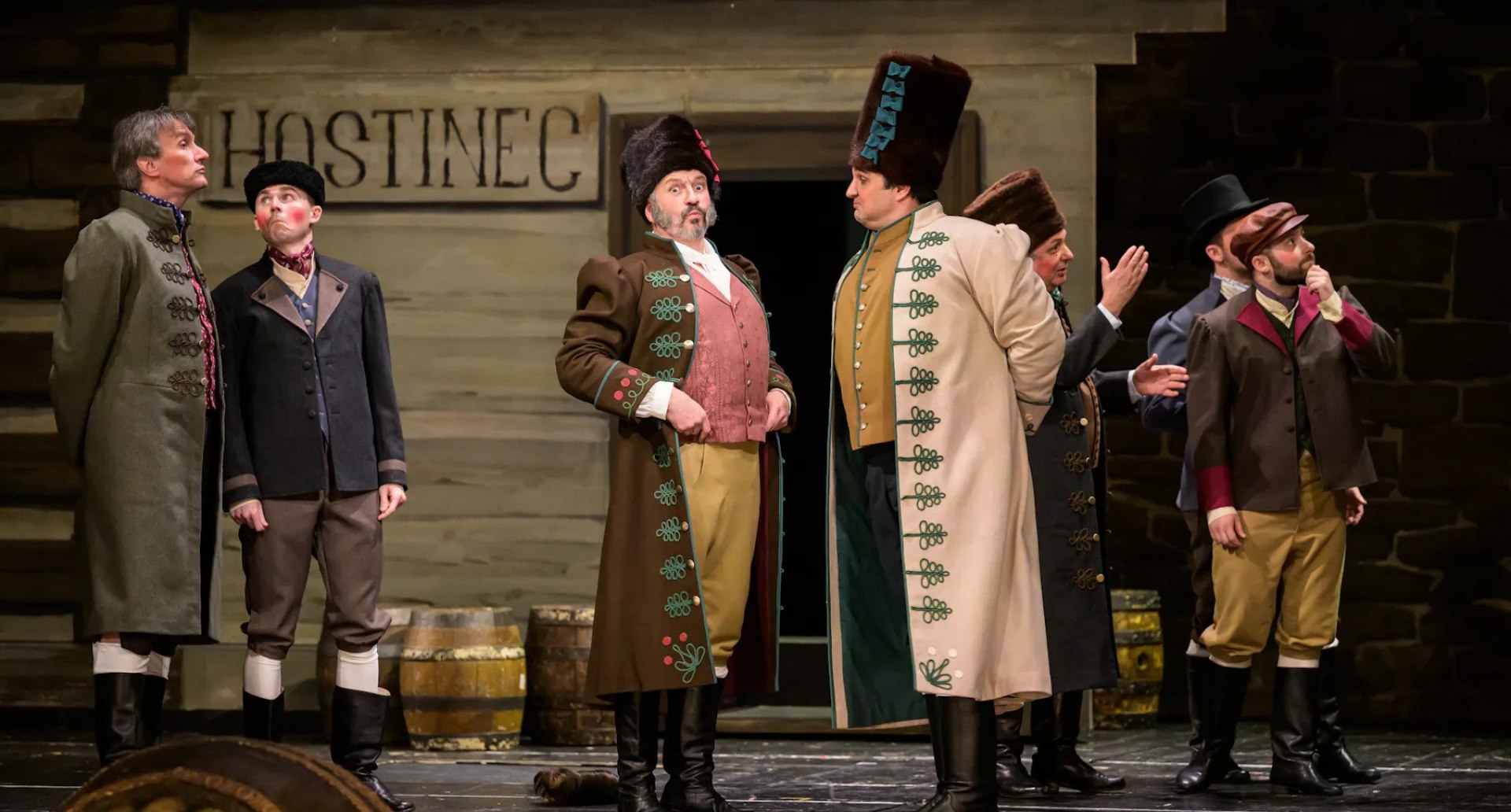
© Serghei Gherciu
The Secret
Order tickets
December 2025 | ||||||
|---|---|---|---|---|---|---|
Mo | Tu | We | Th | Fr | Sa | Su |
Approximate running time: 2 hours 30 minutes, 1 intermission (20 minutes) minutes
Language: In Czech, surtitles in Czech, English
The Secret is Bedřich Smetana’s seventh, and penultimate, opera. It is also the second fruit of the composer’s collaboration with the librettist Eliška Krásnohorská. Completed in June 1877, the piece received its premiere the following year at the New Czech Theatre in Prague. The National Theatre first staged the opera on 12 May 1885, on the first anniversary of Smetana’s death. Yet it only attained wide popularity after the post of the opera company’s director had been assumed by the conductor Karel Kovařovic, who was fully aware of the qualities of the mature Smetana work. Krásnohorská furnished Smetana with an exquisite libretto, whose themes may bring to mind William Shakespeare’s Romeo and Juliet or the Czech author Ladislav Stroupežnický’s play Our Uppish and Defiant Fellows, dating from a later time. The story, set in a small Czech town, focuses on a feud between the families of the councillors Malina and Kalina, who for years have jostled for social superiority. Kalina strives to prove that he is not as poor as he was two decades ago, when Malina thwarted him when he wanted to marry his sister Róza. Despite the hostility between their fathers, Malina’s daughter Blaženka and Kalina’s son Vít love each other. All disputes are ultimately settled after the discovery of an old note by Friar Barnabáš, which leads Kalina to a treasure. But are piles of gold the most precious thing to be found? Smetana’s The Secret has been undertaken by Ondřej Havelka, a stage director possessing an acute sense for music theatre and humour, noted for his visually captivating storytelling. The production will be conducted by Robert Jindra, the music director of the National Theatre Opera.
National Theatre Chorus
National Theatre Orchestra
National Theatre Opera Ballet
Program and cast
Conductor: Jan Chalupecký
Malina - Zdeněk Plech; František Zahradníček
Kalina - Svatopluk Sem; Adam Plachetka
Miss Róza - Jana Kurucová; Lucie Hilscherová
Blaženka - Markéta Klaudová; Jana Sibera
Vít - Petr Nekoranec; Aleš Briscein
Bonifác - Pavel Švingr; Jan Martiník
Skřivánek - Martin Šrejma; Josef Moravec
Master bricklayer - Csaba Kotlár; Jiří Hájek
Innkeeper - Maria Kobielska; Tamara Morozová
Jirka - Daniel Matoušek; Petr Levíček
Ghost of Friar Barnabáš - Jiří Sulženko; Miloš Horák
Eliška Krásnohorská - Lucie Mohr; Alexandra Aldunina
Bedřich Smetana - Beno Blachut; Zbyněk Šporc
Stage director: Ondřej Havelka
Set designs: Martin Černý
Costume design: Barbora Maleninská
Choreography: Jana Hanušová
Chorus master: Lukáš Kozubík
Dramaturgy: Beno Blachut
National Theatre Chorus
National Theatre Orchestra
National Theatre Opera Ballet
Prague National Theatre
The National Theatre today
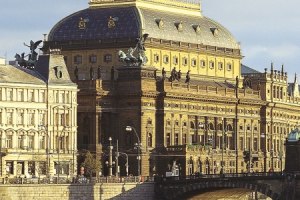
The historical building of the National Theatre, constructed in 1883, is generally considered the prime stage in the CzechRepublic. It is the flagship of the National Theatre institution, today amounting to five buildings and encompassing four companies. You can see there Opera, Drama and Ballet performances.
Practical information
Where to buy tickets
When purchasing online, you can get an e-ticket. You can pick up printed tickets in person at the box offices of the National Theatre.
The National Theatre sells tickets up to 6 months in advance.
Sales always start on the 1st day of the month at 9am, except in January when pre-sales do not start until the 2nd day due to a public holiday.
When do the doors open prior the show?
The National Theatre, The State Opera and the Estates Theatre are open 45 minutes prior the performance in time of increased hygiene practices. The evening box offices are open at the same time.
The main box office at the New Stage on play days is open until the beginning of the show. The New Stage auditorium is open 30 minutes prior the performance.
What kind of dress is suitable for attending the theatre?
Dress codes are only required for special events. By their appearance, the visitors indicate that they are aware of the festive occasion they are experiencing at the theatre. Persons in markedly soiled clothes and persons whose behaviour may compromise the safety of the other visitors are not allowed to enter the respective premises, or can be ejected from them.
Where do I park?
While visiting the National Theatre and the New Stage, you are welcome to use the underground National Theatre car park (access from Ostrovní Street). Please note that the parking is subject to a fee.
Only non-cash payments: Parking fees can be paid exclusively by cashless payment card or another virtual device (watch or phone). Thank you for your understanding
Buffets at the State Opera
No waiting. For your benefit, please pre-order your food and beverages at the bar to minimize waiting in the queue!
Accessibility for the disabled
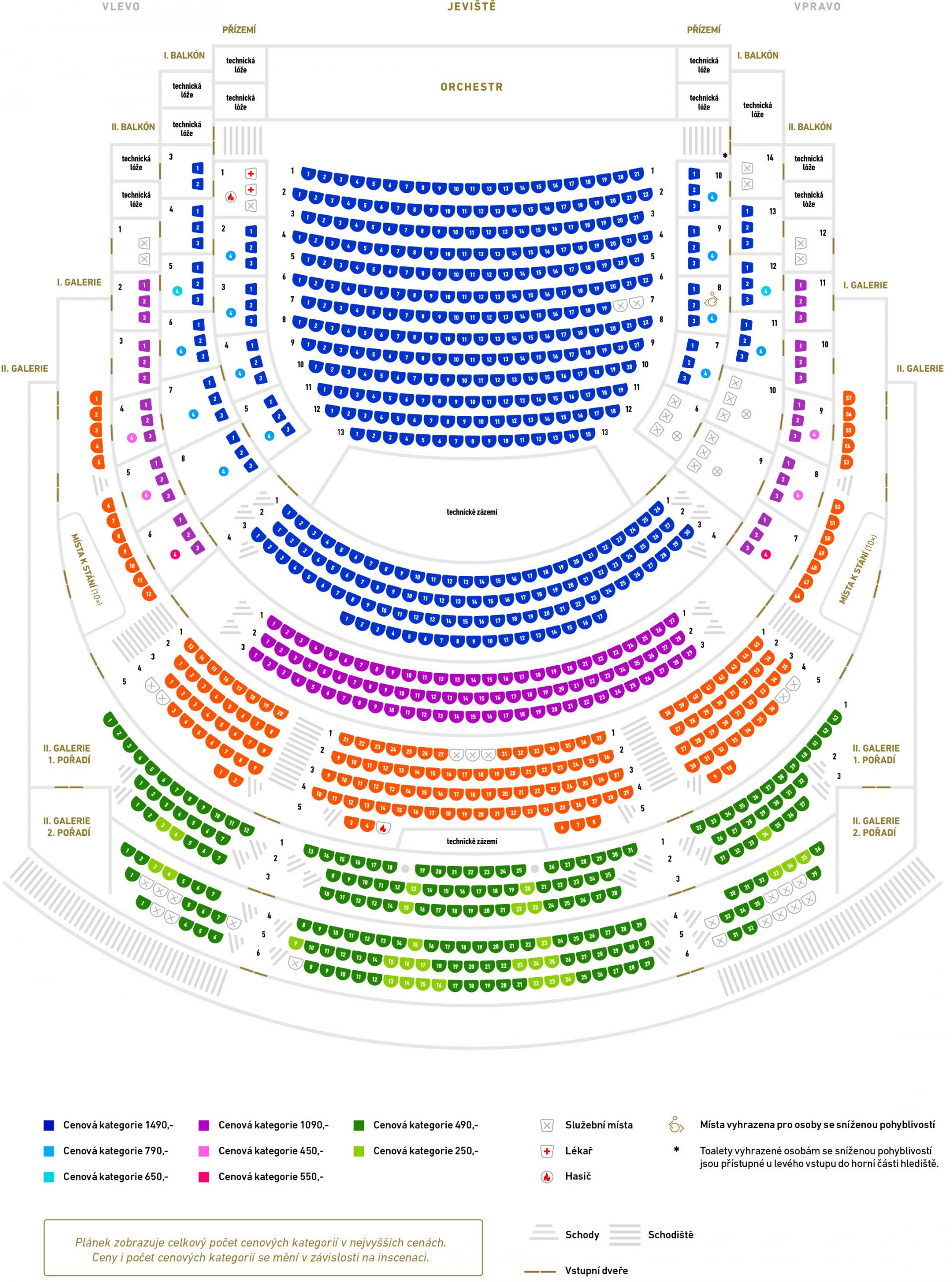
All the National Theatre venues are accessible to disabled persons, with special seats allocated for them in the auditorium. It is, however, advisable to consult each visit in advance with the National Theatre Sales Department.
Can I get an artist’s signature? Can I leave them flowers?
The National Theatre does not provide signatures of artists or contacts to them. You can leave flowers for artists performing in the show before its beginning at the theatre stuff.
Idea of building a stately theatre for the Czech nation
The National Theatre is the embodiment of the will of the Czech nation for a national identity and independence. Collections of money among the broad mass of the people facilitated its construction and hence the ceremonial laying of its foundation stone on 16 May 1868 was tantamount a nationwide political manifestation.
The idea of building a stately edifice to serve as a theatre was first mooted in the autumn of 1844 at meetings of patriots in Prague. It began to materialise through a request for “the privilege of constructing, furnishing, maintaining and managing” an independent Czech theatre, which was submitted to the Provincial Committee of the Czech Assembly by František Palacký on 29 January 1845. The privilege was granted in April 1845. Yet it was not until six years later – in April 1851 – that the Society for the Establishment of a Czech National Theatre in Prague (founded in the meantime) made its first public appeal to start collections. A year later the proceeds of the first collections allowed for the purchase of land belonging to a former salt works with the area of less than 28 acres, which predetermined the magnificent location of the theatre on the bank of the river Vltava facing the panorama of Prague Castle, yet at the same time the cramped area and trapezoidal shape posed challenging problems for the building’s designers.
By tram
By daytime trams Nos. 6, 9, 18 and 22 and night trams Nos. 53, 57, 58, 59 to the stop “Národní divadlo” – in front of the NT historical building; by daytime tram No. 17 to the stop “Národní divadlo”.
By metro
To the station “Můstek”, line B (yellow), and then by foot on Národní street; or to the station “Karlovo náměstí” and then two stops by tram No. 6, 18 or 22 to the stop “Národní divadlo”. To the station “Staroměstská”, line A (green), and then two stops by tram No. 17 to the stop “Národní divadlo”.
Related events